
Hazardous Sites & Substances
- Hazardous Sites and Substances Home
- Hazardous Waste Sites
- Topics
- Choose Safe Places Minnesota
- Environmental Exposures Grand Rounds
- Exposure and Health Investigations
- Contact us
Related Topics
- Water Contaminants and Your Health
- Cancer and the Environment
- Fish Consumption Guidance
- Children's Environmental Health
- Air Quality by Topic
- MN Public Health Data Access Portal
Environmental Health Division
Contact Info
Healthy Soils, Healthy Communities – soilSHOP
Lead can be present in soil from many historical sources, such as old paint, past industrial activity, previous use of leaded gasoline, or it can be naturally occurring. Many Minnesota residents may not know that lead in soil can pose a health risk, especially for children who play outdoors or families who grow food in their yards.
The Minnesota Department of Health (MDH) is working to increase awareness of these risks and help communities take steps to reduce exposure.
soilSHOPs build local capacity
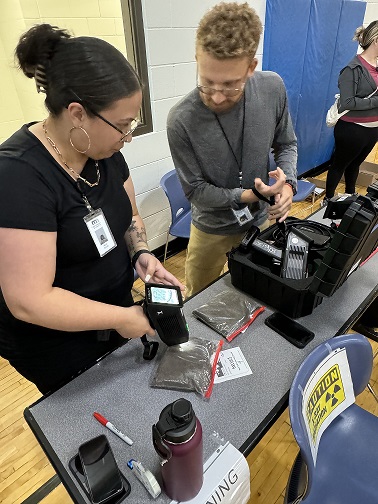
soilSHOP events are designed to raise awareness about lead in soil, provide clear health education, and connect people with resources to help reduce exposure. Community members can bring soil from their yards, gardens, or play areas to be screened for lead on-site. soilSHOP stands for “Soil Screening, Health, Outreach, and Partnership.” These events were developed by the Agency for Toxic Substances and Disease Registry (ATSDR).
MDH staff support local public health partners by using an X-ray fluorescence (XRF) device to screen soil samples for lead. Health educators then walk participants through the results using plain language so they understand what the findings mean and what steps they can take minimize exposure. They also provide educational materials and resources to families, gardeners, renters, homeowners, and community organizations.
2026 soilSHOP events
In 2026, MDH Environmental Health staff traveled across the state to participate in about a dozen soilSHOP events. These events significantly expanded the reach of this educational effort, which began with only two pilot events in 2024.
Throughout the summer, cities, counties, Tribal nations, clinics, and students all partnered with MDH to host or support soil screening events and presentations. These activities emphasized the importance of knowing what is in your soil and building community capacity to address lead risks.
Local partners helped screen 797 soil samples.
- Dakota County
- Douglas County
- Freeborn County
- Goodhue County
- Leech Lake
Band of Ojibwe - Minnesota State Fair 2026
- Native American Community Clinic
- Nicollet County
- Ramsey County
- St. Joseph
- Swift County
- University of Minnesota
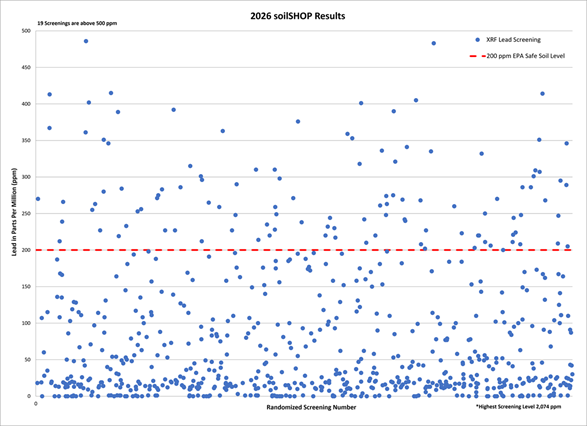
- 797 Total readings
- 46 Readings were Non-Detect (ND)
- 618 Soil readings were below the EPAs safe lead level of 200 ppm
- 133 Soil readings were above the EPAs safe lead level of 200 ppm
- Lowest detectable reading 0.92 ppm
- Highest detectable reading 2,074 ppm
- Average of readings less than 200 ppm 50 ppm
- Average of readings greater than 200 ppm 367 ppm
- Average of all readings 105 ppm
MDH does not set a single background lead level for Minnesota soils. Because soil lead concentrations can vary widely across the state, soilSHOP results help participants understand what is present on their own property and learn practical ways to reduce exposure – such as mulching play areas, using raised beds for gardening, or covering bare soil.
Continued community engagement
MDH will continue collaborating with local public health agencies and community partners to offer soilSHOPs and related educational outreach. These events help strengthen community understanding of environmental health risks and support healthier homes, gardens, and neighborhoods across Minnesota.
How to request a 2027 soilSHOP
If you are interested in hosting a soilSHOP, connect with MDH by phone at 651-201-4897 or email at health.hazard@state.mn.us.
Resources
Learn more about lead and lead contaminated soil at the MDH webpages - Common Sources of Lead and Lead Contaminated Soil.
This web page was made possible by a cooperative agreement [program # TS-23-0001] from the Agency for Toxic Substances and Disease Registry (ATSDR). Its contents are solely the responsibility of the authors and do not necessarily represent the official views of the ATSDR, or the U.S. Department of Health and Human Services.