
Health Care Homes
Strategic Planning
In response to many changes in the health care landscape over the last several years, in late 2024 Health Care Homes began an inclusive strategic planning process that is expected to be complete by June 2026.
Below are HCH’s strategic priorities, developed in active consultation with external key stakeholders. This is a “working” plan, meaning:
- Our mission is clear, challenging, and accurately describes our work, which is directed by state statute and MDH requirements, and guided by our partners and the people served by Health Care Homes. We review our mission as needed to ensure alignment over time.
- Goals look out 10-15 years and are written as outcomes. We review these annually to ensure they continue to challenge us to live our mission and advance toward our vision.
- Key strategies look out 3-5 years. We review these at least annually as we make progress on the action steps that underlie them, and refine or replace them to ensure continuous improvement in service to our mission, vision, and those we serve.
Check back regularly as we report our progress and continue to engage stakeholders to improve our work.
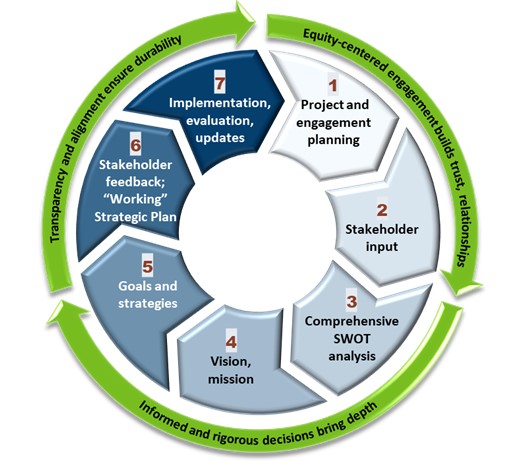
Process, Background
HCH’s rigorous and inclusive strategic planning process began in 2024 and engaged internal and external key stakeholders to develop a vision, mission, long-term goals, and key strategies, along with shorter-term actions that together advance those critical priorities.
This process was and continues to be successful thanks to insights and guidance from:
- Certified clinicians and clinics
- Patients served by HCH-certified clinics, through patient advisory groups
- HCH staff and key MDH leadership
- Research and study partners
- Program collaborators, supporters, and resources from MDH and other state agencies
To learn more about stakeholder contributions to our initial planning process, see the Analysis of Round 1 Input (PDF) or Round 2 Feedback Results (PDF).
Engagement Commitments
Core Values
In our strategic planning process, HCH is committed to the following engagement core values.
Stakeholder engagement…
- Is based on the belief that those who are affected by a decision have a right to be involved in the decision-making process.
- Includes the promise that the stakeholder contributions will influence the decision.
- Promotes sustainable decisions by recognizing and communicating the needs and interests of all participants, including decision makers.
- Seeks out and facilitates the involvement of those potentially affected by or interested in a decision.
- Seeks input from participants in designing how they participate.
- Provides participants with the information they need to participate in a meaningful way.
- Communicates to participants how their input affected the decision.
Source: Adapted from the International Association for Public Participation
Code of Ethics
In our strategic planning process, HCH is committed to the following engagement Code of Ethics. These principles guide us in our practice of enhancing the integrity of the engagement process. We hold ourselves accountable for these principles and strive to hold all participants to the same standards.
- Purpose. We support public participation as a process to make better decisions that incorporate the interests and concerns of all affected stakeholders and meet the needs of the decision-making body.
- Role of Practitioner. We will enhance the public's participation in the decision-making process and assist decision-makers in being responsive to the public's concerns and suggestions.
- Trust. We will undertake and encourage actions that build trust and credibility for the process among all the participants.
- Defining the Public’s Role. We will carefully consider and accurately portray the public's role in the decision-making process.
- Openness. We will encourage the disclosure of all information relevant to the public's understanding and evaluation of a decision.
- Access to the Process. We will ensure that stakeholders have fair and equitable access to the public participation process and the opportunity to influence decisions.
- Respect for Communities. We will avoid strategies that risk polarizing community interests or that appear to "divide and conquer."
- Advocacy. We will advocate for the public participation process and will not advocate for interest, party, or project outcome.
- Commitments. We ensure that all commitments made to the public, including those by the decision-maker, are made in good faith.
- Support of the Practice. We will mentor new practitioners in the field and educate decision makers and the public about the value and use of public participation.
Engagement Objectives
For our strategic planning process, HCH has identified the following engagement objectives.
- Background and process:
- Provide information on the full range of HCH’s work and the different groups we serve.
- Explain the known challenges and opportunities facing HCH.
- Ensure participants understand the purpose, process, and timing of this strategic planning effort.
- Inclusive engagement:
- Demonstrate our commitment to listening to our stakeholders and incorporating their feedback and perspectives into HCH’s strategic plan.
- Engage stakeholders with a broad range of perspectives.
- Reach out to and listen to underrepresented stakeholders; deepen the engagement of stakeholders who have had limited involvement.
- Understand:
- Ask big-picture questions about HCH that encourage people to think 10-15 years into the future.
- Ask various stakeholder groups about their challenges, opportunities, and future needs.
- Build connections:
Create opportunities for different groups of stakeholders to learn from each other.
Engagement Goal and Promise
Level of engagement: Involve

To work directly with stakeholders throughout the process to ensure that their concerns and aspirations are consistently understood and considered.
We will work with you to ensure that your concerns and aspirations are directly reflected in the alternatives developed and provide feedback on how stakeholder input influenced the decision.
Source: © International Association for Public Participation
Key Stakeholders
For our strategic planning process, HCH will actively reach out to and gather input and feedback from the following groups of key stakeholders:
- Certified clinicians and clinics
- Patients served by certified clinics (through patient advisory groups in certified clinics with which HCH is connected)
- HCH staff and key MDH leadership
- Research and study partners
- Program collaborators, supporters, and resources from MDH and other state agencies
Phases, Timeline
| Phases | Timeline |
|---|---|
| 1. Kickoff, Project and Engagement Planning | Fall 2024 |
| 2. Stakeholder Input | Fall 2024 - February 2025 |
| 3. Comprehensive SWOT | Winter 2025 |
| 4. Vision and Mission | Spring 2025 |
| 5. Goals and Strategies | Spring 2025 |
| 6. Stakeholder Feedback, Final Strategic plan | Summer 2025 |
| 7. Implementation Support | Summer 2026 and beyond |