
Children and Youth with Special Health Needs (CYSHN)
Programs
- Birth Defects Monitoring and Analysis
- Early Hearing Detection and Intervention
- Follow Along Program
- Longitudinal Follow-up for Newborn Screening Conditions
Related Sites
Contact Info
About the Children and Youth with Special Health Needs Section
Vision
A Minnesota where all children and youth with special health needs and disabilities can live a life of dignity, opportunity, joy, and belonging.
Mission
We work together to champion the health and well-being of Minnesotans with special health needs and disabilities from the earliest stages of life through transition to adulthood.

Birth Defects Monitoring and Analysis
Gathers data about selected birth defects diagnosed in the first year of life, estimated to affect over 2,000 babies born in Minnesota each year.
Longitudinal Follow-up for Newborn Screening Conditions
Builds the capacity of systems that serve families of children and youth with special health needs who are identified through newborn screening.
Helps families track their child's development and let them know if their child is playing, talking, growing, moving, and behaving like other children the same age.
Early Hearing Detection and Intervention
Provides information and resources for Minnesota parents, families, and providers as they navigate newborn hearing screening, the follow-up process, and planning to support a child who is identified as deaf or hard of hearing.
Family Support Organization Collaborative
Where family support organizations come together to collaborate, share knowledge, and build lasting partnerships. Through gatherings, the collaborative co-creates strategies to better serve families. Its goal is to improve systems by leveraging the collective wisdom and resources of organizations across Minnesota.
Pediatric Care Coordination: Community of Practice
Provides a way for care coordinators to network, collaborate, share, and learn from each other. These activities build the capacity of systems that serve families of children and youth with special health needs.
Local Public Health Partner Resources
Contains information for LPH contacts who provide follow-up for children with birth defects and conditions identified through newborn screening and implement the Follow Along Program.
A medical home is often the clinic or doctor’s office where a child goes for their regular health care– like checkups, sick visits, and help managing ongoing health needs. But it’s more than just a building or a place. It’s a way of providing care that puts the child and family at the center.
Transitioning to Adult Healthcare
Transitioning to Adult Health Care can be challenging for those with health complexities. Laying the groundwork for successful lifelong, positive health outcomes is a shared responsibility by health care systems, providers, adolescents, and families. This page details the need to ensure youth with special health needs are able to make this transition successfully.
Respect for identities
In our commitment to inclusivity and respect for all identities, we strive to use language that honors each individual’s preferences and lived experiences. We recognize that having a health condition or disability is a natural and valuable part of human diversity, and that language used to describe identity is both personal and evolving. For example, some people with disabilities prefer identity-first language (e.g., “disabled person”), others prefer person-first language (e.g., “person with a disability”). We respect these differences and aim to use descriptors relevant to the context and only when essential. We strive to stay responsive and open to changing our terminology as language evolves.
In alignment with federal and state statutory language, our program uses the term “special” in the title Children and Youth with Special Health Needs and Disabilities. We acknowledge that for some, the term “special” is considered problematic and may imply a sense of “otherness” rather than inclusion. While this language reflects current terminology, we remain open to exploring ways to address and evolve its usage in response to community feedback. Our goal is to communicate in ways that reflect each person’s preferred identity and foster a sense of belonging and respect.
Our approach to inclusive language emphasizes relationship-building, respecting each person’s chosen identity, and acknowledging that preferences can change over time. This statement serves as general guidance, as we understand that meaningful connection with individuals and communities is essential to fully respecting their identities.
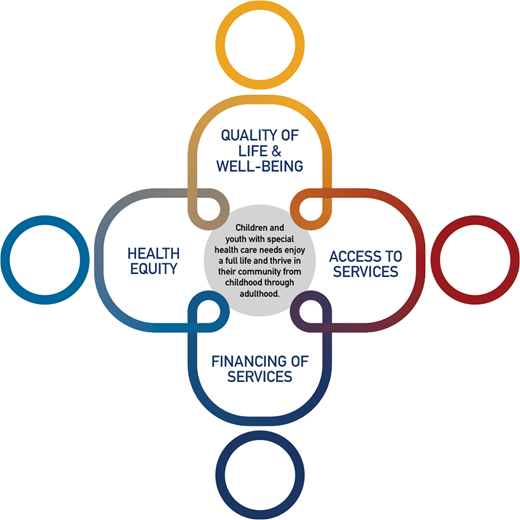
- Families of CYSHCN are partners in decision making at all levels
- CYSHCN receive coordinated, ongoing, comprehensive care within a medical home
- Families of CYSHCN have adequate private and/or public insurance
- Children are screened early and continuously for special health care needs
- Services for CYSHCN are organized so families can use them easily and are satisfied with the services they receive
- Youth with special health care needs receive the services necessary to make transitions to all aspects of adult life, including adult health care, work, and independence
References
- Conners Edgeworth, D., Boudreau, A. D., AlHajri, B., & Berry, J. G. (2022). Addressing health care inequities in children with medical complexity. Pediatrics, 149(Supplement 7), e2021056150C. https://doi.org/10.1542/peds.2021-056150C.
- Perrin JM, Romm D, Bloom SR, et al. A family-centered, community-based system of services for children and youth with special health care needs. Arch Pediatr Adolesc Med. 2007;161(10):933–935. https://publications.aap.org/view-large/9700748.
- Maternal and Child Health Advisory Committee provides guidance on the health care needs of mothers and children throughout the state of Minnesota. Task Force work includes providing recommendations on preconception health strategies and activities related to supporting children and youth with special health needs.
- Newborn Hearing Screening Advisory Committee provides guidance in developing protocols and timelines for screening, rescreening, and diagnostic audiological assessment as well as early intervention services for children who are deaf or hard-of-hearing.
- Newborn Screening Advisory Committee provides advice and recommendations concerning tests and treatments for heritable and congenital conditions found in newborns, including making informed recommendations to add new disorders to the newborn screening panel.
- Minnesota Interagency Developmental Screening Task Force is a statewide coordination of screening efforts and consistent developmental screening standards. The vision of the task force is for all children in Minnesota to be at their optimal health and development and ready to learn.