
Transforming Minnesota's Public Health System
- Home: System Transformation
- About This Work
- Framework of Foundational Responsibilities
- Definitions, Criteria, and Standards for Fulfillment
- Joint Leadership Team
- Minn. Infrastructure Fund and Local Innovation Projects
- Governance Groups and Communities of Practice
- Data Modernization
- Regional Data Models
- Tribal Public Health Capacity and Infrastructure
- FPHR Grant: Funding for Foundational Responsibilities
- Reports, Fact Sheets, Resources
- News & Blog: Public Health System Transformation Update
- Message Toolkit
Related Sites
Contact Info
Foundational Public Health Responsibilities and Framework
Transforming the public health system in Minnesota
This framework does not convey roles and responsibilities (e.g., who carries out which activity), and does not discuss how much of each activity, capability, or area any specific jurisdiction "owns."
On this page
Framework of foundational public health responsibilities
At a glance: What are foundational responsibilities?
What's considered "foundational" in Minnesota? (resources)
Related work and groups
Framework of foundational public health responsibilities
Governmental public health must carry out the foundational public health responsibilities, and the responsibilities must be present in every community across the state to efficiently and effectively promote and protect the health of all people in Minnesota.
The responsibilities consist of five areas and eight capabilities, encircled by equity.
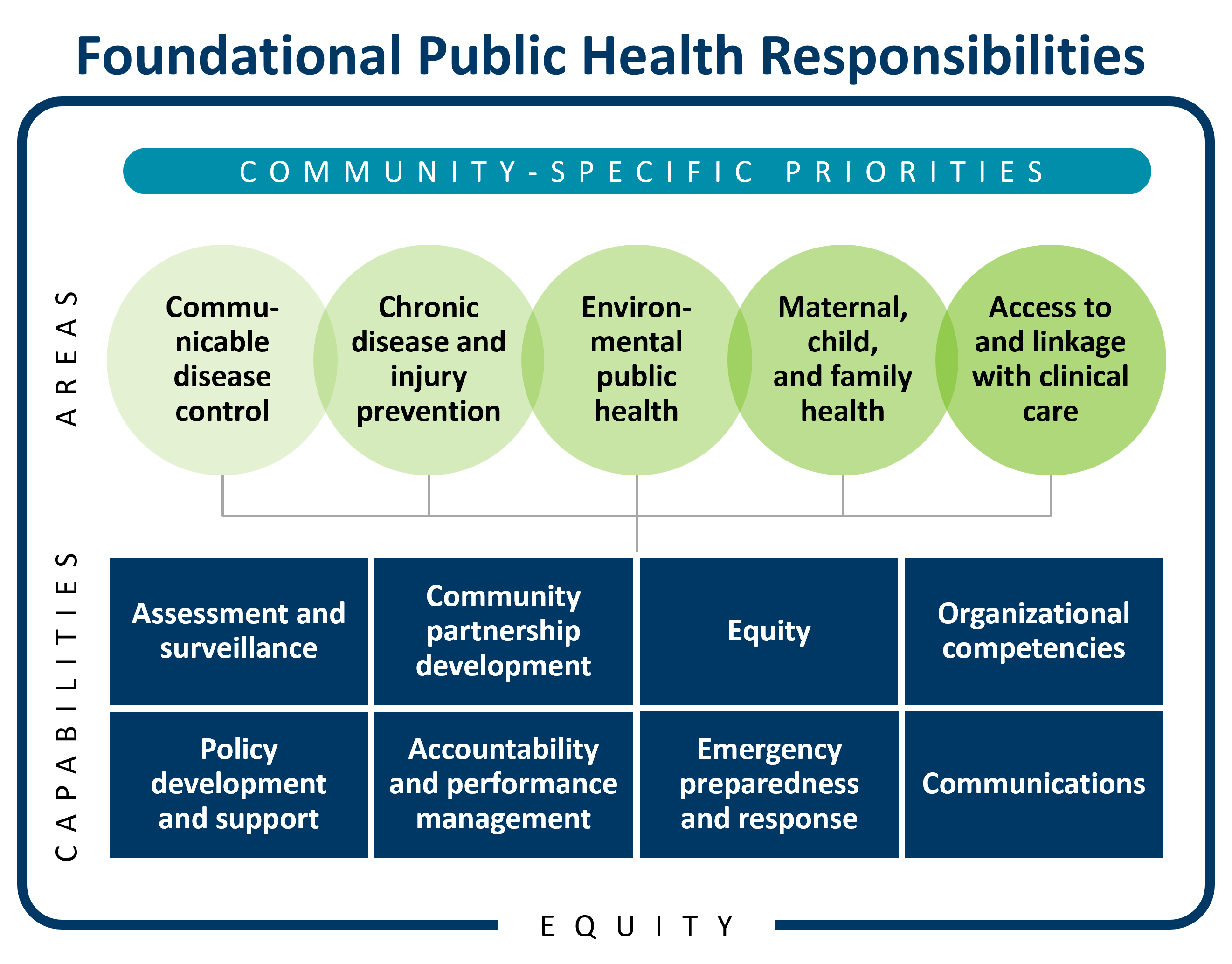
Capabilities are the cross-cutting skills and abilities that make up the foundation for all public health work. If we use the metaphor of a house, capabilities can represent the house's foundation. All houses need a strong foundation for the rest of the house to function properly. The house's utilities are connected to the foundation and run through all rooms of the house. Similarly, all of public health’s work is undergirded by a strong foundation built of these capabilities; they enhance and strengthen all parts of public health work, whether foundational or community-specific.
Areas are the population-level, topic-based work unique to governmental public health. Areas can represent the rooms of our "house" in that there are some parts of a house that are universal, like a kitchen, bathroom, bedrooms, etc. In the same way, Minnesotans should see public health working in their jurisdictions in these five areas of work, no matter where they live.
Community-specific priorities are the programs and services that governmental public health agencies provide beyond the foundational capabilities and areas noted above, according to local need, desire, and opportunity. They could be represented by the unique needs and decisions of each homeowner for their individual houses, like furniture, paint color, fixtures, etc. They are still very important, but are not the same in every house. Similarly, health departments will provide additional services and may require more capacity in different areas to best serve their communities. For examples of what community-specific priorities might look like, go to p. 3 of A new framework for governmental public health in Minnesota (PDF).
Equity encircles all areas, capabilities, and community-specific priorities: Work in foundational areas and capabilities happens through an equity lens, in addition to equity being its own distinct capability.
What does this framework do?
Where you live should not determine your level of public health protection.
This framework outlines the foundational responsibilities of the governmental public health system. It defines what needs to be in place everywhere for Minnesota's public health system to work anywhere, as we work toward a more seamless, responsive, and publicly-supported public health system.
- It can help us explain the vital role of governmental public health in a thriving community.
- It helps us identify capacity gaps, ask for support, evaluate progress, and justify resource and funding needs.
- It also acknowledges that, in addition to a statewide foundation, health departments will provide additional services and may require more capacity in different areas to best serve their communities.
This framework does not convey roles and responsibilities (e.g., who carries out which activity), and does not discuss how much of each activity, capability, or area any specific jurisdiction "owns."
What's considered "foundational" in Minnesota?
Start with:
- Definitions, Criteria, and Standards for Fulfillment of Foundational Public Health Responsibilities: These definitions, criteria, and standards can help us understand what's considered "foundational" and why, and how to demonstrate foundational responsibilities are fulfilled in a jurisdiction.
Dig in:
- Overview Webinar: Foundational Public Health Responsibilities: This informational session can help us understand the framework of foundational public health responsibilities (capabilities and areas).
- Community of Practice for Foundational Public Health Responsibilities: This community of practice provides a space for local public health departments to share and learn about activities related to foundational public health responsibilities