
Environmental Health Division
Rulemaking Process
Minnesota's rulemaking process is governed by Minnesota Administrative Procedure Act (APA) in Minnesota Statutes, chapter 14. In this process there are steps and timelines for developing and adopting rules.
Simplified outline
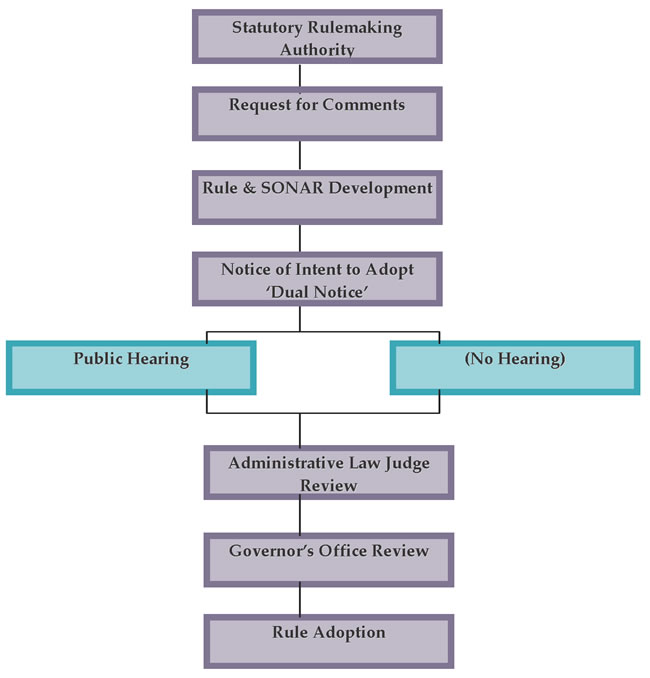
Preliminary review
Rulemaking is undertaken within the purview of statues that authorize agencies to propose or amend rules. Key to rulemaking is getting input and feedback from interested persons on the subject of the proposed rule.
Publish Request for Comments
The Request for Comments is published in the State Register and initiates the rulemaking process. Comments may be submitted in writing or orally.
Develop proposed rules and SONAR
Agencies develop and draft the proposed rules. The Revisor of Statutes reviews the rules for form and style, and prepares the final rule draft for publication in the State Register. The agency is required to justify the need and reasonableness of each rule requirement. The Statement of Need and Reasonableness (SONAR) is the justification document that contains the analysis of each requirement in the rules, the agencies statutory authority for the rules, and a regulatory analysis.
Publish Notice of Intent to adopt
When the proposed rule revisions are complete, agencies publish a Notice of Intent to Adopt Rules in the State Register, along with the proposed rule revisions. The Notice of Intent may take the form of adoption without a hearing, a “Dual Notice” or a Notice of Hearing.
Public hearing
An agency must conduct a public hearing on proposed rules if 25 or more people submit a written request for a hearing or if the agency has published a Notice of Hearing directly. If no public hearing is required, the agency presents its own evidence to the Court of Administrative Hearings.
Comment period
After the Notice of Intent is published, there is a comment period that is at least 30 days, during which interested parties and affected stakeholders may submit written comments on the proposed rules. This comment period can be lengthened at the ALJ's discretion. The Governor’s Office is also notified about results of the comment period.
Administrative Law Judge (ALJ) review
The ALJ reviews the proposed rules and all exhibits from the hearing (if a hearing was held) to determine if the agency has demonstrated that it has statutory authority for the rules, has shown the rules to be needed and reasonable, has given proper notice of the proposed rules, and has complied with all other rulemaking requirements. If the rules are approved, the agency signs an Order Adopting rules and sends it to the Court of Administrative Hearings so that they may make notifications. If the rules are not approved, the agency might make modifications or withdraw the rule.
Final review
The Secretary of State then sends the approved rules to the Governor. The Governor has 14 days to review the approved rules during which time he may veto the proposed new rules or rule amendments.
Publish Notice of Adoption
After the Governor’s review and veto period, the agency publishes Notice of Adoption in the State Register.
Timeline
This process of drafting rules can take several months or years depending on the level of interest and stakeholder engagement. The formal, or procedural, part of the rulemaking process, from publishing the Notice of Intent to Adopt Rules until the date the rules become effective, takes approximately five months if there is a hearing.