
Per- and Polyfluoroalkyl Substances (PFAS)
Related Topics
- Drinking Water
- Water Contaminants and Your Health
- Special Well and Boring Construction Areas
- Wells and Borings
- MDH Guidance
- Air Quality by Topic
Environmental Health Division
Contact Info
PFAS and Products
Per- and polyfluoroalkyls (PFAS) are a large family of human-made chemicals widely used since the 1950s. They resist heat, grease, oil, and water, which is why they show up in many everyday products. These features make PFAS useful, but they also make the chemicals extremely persistent and harmful.
High levels of PFAS have been found in the environment in part due to their use in consumer products. They have also been found to build up in the body. There is a risk of PFAS exposure and pollution whenever a product containing PFAS is made, used, or disposed of. Some PFAS cannot be quickly excreted by the body, resulting in elevated levels inside the body even after exposure is reduced or eliminated.
How products contribute to PFAS exposure
PFAS can enter the body or environment when products:
- Shed PFAS-containing dust.
- Wear down or break apart.
- Leach chemicals into food.
- Leave residues on skin or indoor surfaces.
- Are washed, sending PFAS into wastewater.
- Are disposed of, releasing PFAS into the soil, groundwater, or air.
This means that PFAS in products are not only a human safety issue, but they are also an environmental exposure issue.
PFAS are used across many industries. Products that may contain them will vary by state due to differing state laws and may include:
Food-related items
- Fast-food wrappers and bags
- Microwave popcorn bags
- Bakery and deli papers
- Takeout containers
- Nonstick cookware
- Grease-resistant tools or packaging
- Large and small kitchen appliances
Clothing and outdoor gear
- Water-or stain resistant shoes, jackets and clothing
- Tents, backpacks, and outdoor fabrics
Textiles and home goods
- Stain-resistant carpets
- Upholstered furniture
- Mattress pads and some bedding
Cosmetics and personal care products
- Long-lasting or waterproof make up
- Hair products
- Lotions
- Menstrual products
Electronics
- Computer equipment
- Cellphones
- power cords
- Electrical components
Industrial products
- Certain sealants, coatings, and lubricants
Reducing your PFAS exposure from products
Limiting your use of products that contain PFAS can be challenging. For more information on ways to reduce your PFAS exposure, visit the MDH PFAS and Health page. Here are simple ways to reduce exposure from products:
- Be aware of product features that may indicate PFAS use.
Products advertised to be heat, grease, oil, or water resistant.
Some PFAS containing fabric coatings can breakdown in the wash over time reducing the need to replace PFAS containing clothing. - Review third-party certifications when choosing products.
- Labels such as "PFAS-free," "PFOA-free," or "fluorine-free" may indicated reduced PFAS content. However, some certifications allow small amounts of PFAS.
- EPA Sustainable Marketplace website provides information about PFAS-related product certifications and what they mean.
- To learn more about how products are certified and to find certifying organizations, visit the ITRC PFAS Uses and Products website (section2.5.3).
For additional information on reducing exposure to PFAS, visit the MDH PFAS and Health page.
What Minnesota is doing
Minnesota is taking steps to reduce PFAS in consumer products by:
- Identifying product categories that commonly contain PFAS.
- Phasing out PFAS in certain product types where safer alternatives exist.
- Requiring reporitng or disclosure for PFAS-containing products.
- Working to limit PFAS releases from manufacturing and disposal.
Minnesota passed a number of laws in the past few years to reduce the use of PFAS in industry and consumer products. While it may not be possible to eliminate PFAS from all products, these laws will help reduce exposure and pollution. The goal is to protect public health and the environment - and this will also reduce cleanup expenses.
Minnesota state agencies partner on raising awareness about PFAS. If you have specific questions about the laws and rulemaking, please contact the Minnesota Pollution Control Agency (MPCA) at pfasinfo.pca@state.mn.us.
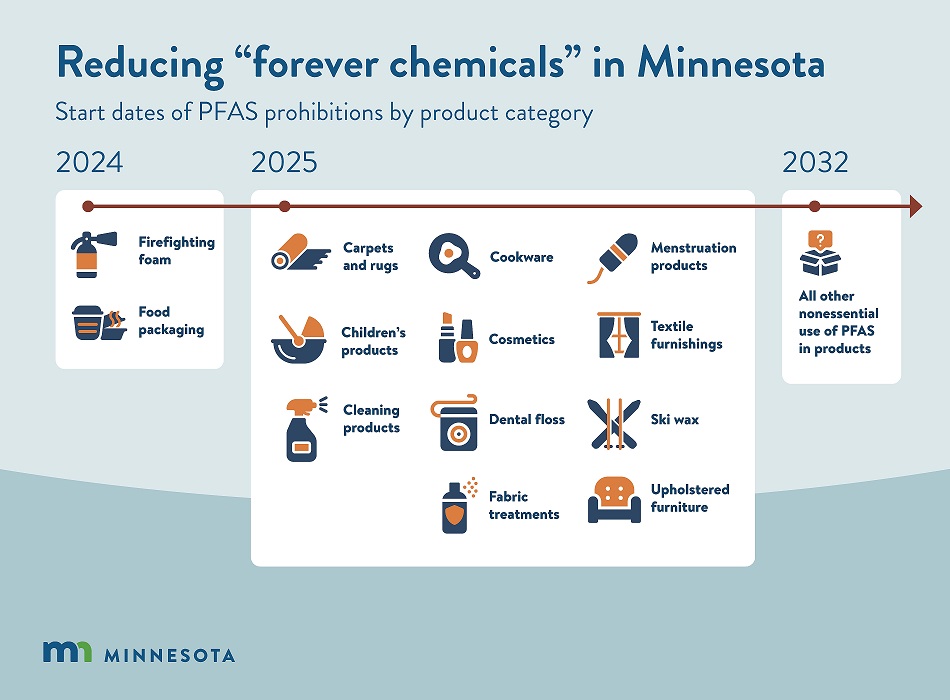
| Minnesota’s PFAS Use Requirements & Prohibitions | Date effective |
|---|---|
| PFAS in firefighting foam for testing or training purposes | July 1, 2020 |
| PFAS in food packaging | January 1, 2024 |
| PFAS in firefighting foam, with exceptions | January 1, 2024 |
| Amara’s Law Phase 1: PFAS in 11 product categories (see categories below) | January 1, 2025 |
| Amara’s Law Phase 2: PFAS in product reporting requirement | September 15, 2026 |
| Amara’s Law Phase 3: PFAS prohibited in all products unless determined to be “currently unavoidable use” | January 1, 2032 |
Carpets or rugs
- Definition: Fabric intended for use as an indoor or outdoor floor covering.
- Examples: carpets, rugs, car floor mats, RV carpeting, outdoor rugs, and synthetic turf.
Cleaning products
- Definition: products used for household, commercial, or institutional cleaning purposes, except those used in industrial manufacturing
- Examples: detergent, stain removers, vehicle cleaning products, glass cleaner, hard surface cleaners
Cookware
- Definition: Items used to prepare, dispense, or store food and beverages
- Examples: Baking sheets, bowls, cooking utensils, electric woks, pots, pans, skillets, grills, baking sheets, baking molds, trays, waffle makers
Cosmetics
- Definition: Products applied to the body to alter its appearance
- Examples: Blushes, eye liners, foundations, toners, lip sticks, lotions, mascaras, nail polish
Dental floss
- Definition: Products designed to clean between teeth
- Examples: Dental floss, dental picks, interdental brushes
Fabric treatments
- Definition: Products that are applied to fabrics after purchase to make them resistant to water, stains and grease
- Examples: Spray-on water repellants, stain protectors, and flame retardants
Juvenile products
- Definition: Any products designed or marketed for use by infants and children under 12 years of age, excluding electronics
- Examples: Car seats, children’s clothing, bassinets, highchairs, nursing pads, playpens, toys, and many more
Menstruation products
- Definition: Products used to catch menstrual flow
- Examples: Disposable and reusable pads, tampons, period underwear, menstrual cups
Textile furnishings
- Definition: Products made with fiber, yarn, or fabric customarily used in households and businesses
- Examples: Draperies, rugs, furnishings, bedding, towels, tablecloths
Ski wax
- Definition: Lubricant applied to the bottom of skis and snowboards
- Examples: Ski and snowboard waxes, related tuning products
Upholstered furniture
- Definition: Furniture with filling material
- Examples: Cushioned chairs, mattresses, recliners, sofas
Printable PDF - PFAS and Products Info sheet (PDF)
Additional resources
- Per- and Polyfluoroalkyl Substances (PFAS) - MN Dept. of Health
- PFAS and Health - MN Dept. of Health
- PFAS in Products - MN Pollution Control Agency
- PFAS Use Prohibitions - MN Pollution Control Agency
- PFAS in Products: Currently Unavoidable Use - MN Pollution Control Agency