
Contact Info
Infectious Disease Epidemiology, Prevention and Control Division
651-201-5414
Last Updated: 07/22/2026
Pneumococcal disease is an infection caused by the bacteria Streptococcus pneumoniae. It can cause pneumonia, bacteremia, or meningitis.
Invasive pneumococcal disease (IPD) is when S. pneumoniae invades parts of the body that are normally free of bacteria, such as the bloodstream and the lining of the brain and spinal cord. IPD can be more severe than pneumococcal pneumonia.
S. pneumoniae bacteria kills more people in the United States each year than all other vaccine-preventable diseases combined. Immunization is becoming increasingly important because of growing resistance to antibiotics used for treating pneumococcal infections.
Pneumococcal vaccine product information and VISs
| Generic name | Manufacturer | Prescribing information | Licensed for | Vaccine Information Statement (VIS) |
|---|---|---|---|---|
| PCV21 | Merck | FDA: CAPVAXIVE | 18 years and older | Immunize.org: PCV (Pneumococcal Conjugate) VIS |
| PCV20 | Pfizer | FDA: PREVNAR 20 | 6 weeks and older | Immunize.org: PCV (Pneumococcal Conjugate) VIS |
| PCV15 | Merck | FDA: VAXNEUVANCE | 6 weeks and older | Immunize.org: PCV (Pneumococcal Conjugate) VIS |
| PPSV23 | Merck | FDA: PNEUMOVAX 23 | 50 years and older 2 years and older at increased risk | Immunize.org: PPSV (Pneumococcal Polysaccharide) VIS |
PCV = pneumococcal conjugate vaccine
PPSV = pneumococcal polysaccharide vaccine
Serotypes included in pneumococcal vaccines currently recommended for adults in the United States

Timing of vaccination is based on a person’s underlying medical conditions, risk factors, and vaccine history. For additional details, including underlying medical conditions and risk factors, refer to the pneumococcal notes section of the AAP (children) and AAFP (adults) immunization schedules found at: Immunization Information for Health Care Providers.
There is no preferential recommendation for the use of any one pneumococcal conjugate vaccine (PCV) over another except in communities with high percentages of serotype 4 pneumococcal disease.
* Underlying medical conditions and risk factors include alcoholism, chronic heart/liver/lung disease, chronic renal failure, cigarette smoking, cochlear implant, congenital or acquired asplenia, CSF leak, diabetes, immunocompromising conditions, HIV infection, malignancy, organ transplant, sickle cell disease, and other recognized pneumococcal disease risk factors.
In communities with elevated rates of serotype 4 IPD, clinicians should consider vaccine products that include serotype 4 coverage. PCV20 and PCV15 include serotype 4 coverage.
Because serotype 4 currently accounts for a high proportion (≥30%) of IPD cases among adults ages 19–49 years in the 7-county Twin Cities metropolitan area (Anoka, Carver, Dakota, Hennepin, Ramsey, Scott, and Washington counties), MDH recommends considering PCV20 over PCV21 for metro area adults aged 19-49 years of age who are indicated to receive pneumococcal vaccination. If PCV20 is unavailable, PCV15 followed by PPSV23 may be used.
Clinicians are encouraged to monitor emerging IPD epidemiology and consider the populations they serve when determining which vaccine products to stock. At this time, MDH does not recommend preferential use of PCV20 over PCV21 outside communities with elevated serotype 4 disease burden.
Pneumococcal disease is an infection caused by the bacterium Streptococcus pneumoniae. It can cause pneumonia, bacteremia, or meningitis.
Between 2017 to 2025, Minnesota recorded a range of 276 to 574 adult (≥19 years of age) invasive pneumococcal disease (IPD) cases per year (median: 436 cases), and 33 to 55 deaths annually (median: 45 deaths).
Adult (≥19 years) Invasive Streptococcus pneumoniae Cases in Minnesota
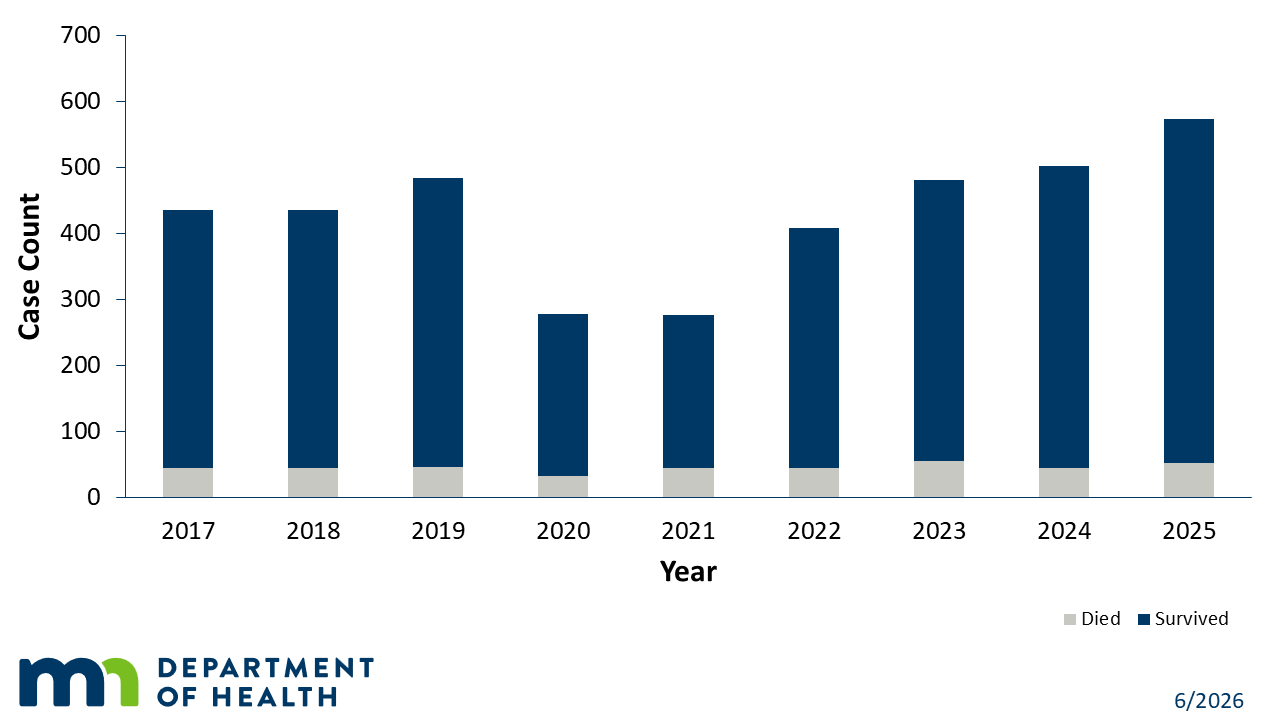
| Outcome | Survived | Died | Total |
|---|---|---|---|
| 2017 | 392 | 44 | 436 |
| 2018 | 390 | 45 | 435 |
| 2019 | 437 | 47 | 484 |
| 2020 | 245 | 33 | 278 |
| 2021 | 231 | 45 | 276 |
| 2022 | 365 | 44 | 409 |
| 2023 | 426 | 55 | 481 |
| 2024 | 457 | 45 | 502 |
| 2025* | 522 | 52 | 574 |
2025 data are preliminary.
9 cases pending outcome data.
An increasing proportion of IPD caused by serotype 4 was first observed in the Western United States (Alaska Colorado, New Mexico, Navajo Nation, and Oregon) as early as 2017.
IPD Caused by serotype 4 occurs across age groups; however, cases are frequently observed among adults aged <65 years who have underlying conditions including, homelessness and injection drug use.
Economic models built by CDC concluded when less than 30% of IPD was caused by serotype 4, PCV21 was less expensive and could save more lives than PCV20. When ≥30% of IPD cases are caused by serotype 4, PCV20, which provides coverage for serotype 4, should be used. These models did not evaluate PCV15 and PPSV23 use CDC: Economic Assessment of PCV21 in U.S. Adults (PDF).
In Minnesota from 2023-2025 (most current data available), the proportion of IPD caused by serotype 4 exceeded 30% among 19–49-year-olds in the Twin Cities metropolitan area (Proportion of IPD caused by serotype 4 by Minnesota Region and Age group, 2020-2025). In Minnesota a higher proportion of serotype 4 IPD cases are <65 years of age, experiencing homelessness, current smokers or have a history of injection drug use compared with IPD cases caused by all other serotypes combined.
Proportion of IPD caused by serotype 4 by Minnesota Region and Age group, 2020-2025*
| Region of Residence | 7-County Metro Area** | Non-Metro Area | ||||
|---|---|---|---|---|---|---|
| Age in Years | 19-49 | 50-64 | 65+ | 19-49 | 50-64 | 65+ |
| 2020 | 0% | 0% | 0% | 4% | 2% | 0% |
| 2021 | 4% | 3% | 0% | 4% | 2% | 0% |
| 2022 | 0% | 2% | 0% | 5% | 2% | 0% |
| 2023 | 36% | 16% | 2% | 0% | 6% | 1% |
| 2024 | 42% | 28% | 9% | 6% | 7% | 1% |
| 2025* | 44% | 19% | 5% | 23% | 10% | 5% |
* 2025 data are preliminary.
** 7- County Metro Area = Anoka, Carver, Dakota, Hennepin, Ramsey, Scott, and Washington counties
When data from 2023-2025 IPD cases were compared, a larger proportion of Twin Cities metropolitan area IPD cases in the 19-49 years old age group were caused by a PCV20-covered serotype (75%) compared with a PCV-21-convered serotype (50%). For Twin Cities metropolitan area IPD cases ≥ 50 years of age and non-metropolitan area IPD cases of all ages, the proportion of IPD caused by a PCV21-covered serotype was equivalent or greater compared with PCV-20 covered serotypes. Clinicians are encouraged to follow the emerging epidemiology of IPD both in the Twin Cities metropolitan area and outside of it.
Proportion of 2023-2025* IPD cases Preventable by PCV20 or PCV21 by Age group:
| Area | Age in Years | 19-49 | 50-64 | 65+ | All Adults (>18) |
|---|---|---|---|---|---|
| 7- County Metro Area | PCV20 covered strain | 75% | 63% | 50% | 61% |
| PCV21 covered strain | 50% | 64% | 79% | 66% | |
| Strain covered by neither | 4% | 10% | 12% | 9% | |
| Non-Metro Area | PCV20 covered strain | 68% | 58% | 51% | 55% |
| PCV21 covered strain | 67% | 80% | 74% | 75% | |
| Strain covered by neither | 7% | 8% | 17% | 13% |
* 2025 data are preliminary.
Some cases had serotypes covered by both PCV20 and PCV21.