
Secondary menu

  • About Us
  • News & Stories
  • Translated Materials
Minnesota Department of Health logo
  • Data, Statistics, and Legislation

    Data, Statistics, and Legislation

    Statistical reports, health economics, policy, and legislation.
    Data, Statistics, and Legislation
    • Community Health
    • Diseases and Conditions
    • Environmental Health
    • Health Behaviors and Risk Factors
    • Health Care Cost and Quality
    • Reporting and Exchanging Data
    • Legislation and Policy
  • Diseases and Conditions

    Diseases and Conditions

    A-Z disease listing, diseases and conditions by type.
    Diseases and Conditions
  • Health Care Facilities, Providers, and Insurance

    Health Care Facilities and Providers

    Directories of facilities, professional certifications, health insurance and patient safety.
    Health Care Facilities and Providers
    • Facility Certification, Regulation and Licensing
    • Insurance
    • Health Information Technology
    • Provider Certifications, Licenses, Registrations and Rosters
    • Patient Health and Safety
    • Health Care Homes
    • Notices Related to Health Records
    • Rural Health and Primary Care
    • Trauma System
  • Healthy Communities, Environments, and Workplaces

    Healthy Communities, Environments, and Workplaces

    Indoor air and drinking water quality, community prevention and emergency preparedness.
    Healthy Communities, Environments, and Workplaces
    • Community Wellness and Health Equity
    • Healthy Schools and Child Care
    • Healthy Businesses and Workplaces
    • Local Public Health
    • Environments and Your Health
    • Safety and Prevention
    • Emergency Preparedness and Response
    • Equitable Health Care Task Force
    • Transforming the Public Health System in Minnesota
  • Individual and Family Health

    Individual and Family Health

    Birth records, immunizations, nutrition and physical activity.
    Individual and Family Health
    • Vital Records and Certificates
    • Disabilities and Special Health Needs
    • Disease Prevention and Symptom Management
    • Healthy Aging
    • Healthy Children, Youth and Adolescents
    • Mental Health and Well-being
    • Reproductive Rights and Protections in Minnesota
    • Women and Infants
MDH Logo

Breadcrumb

  1. Home
  2. Healthy Communities, Environment and Workplaces
  3. Center For Public Health Practice
  4. Tools and Training From The Center For Public Health Practice
  5. Tools and Training - Public Health and QI Toolbox
Topic Menu

Center for Public Health Practice

  • Home: Center for Public Health Practice
  • Assistance & Workforce Development
  • Assessment & Planning
  • Connect
  • Funding Opportunities
  • Healthy Minnesota Partnership
  • Local Public Health Act
  • SCHSAC
  • Tools & Training
  • Contact Us

Related Sites

  • Minnesota Partners in Public Health Conference
  • Transforming Minnesota's Public Health System

Center for Public Health Practice

  • Home: Center for Public Health Practice
  • Assistance & Workforce Development
  • Assessment & Planning
  • Connect
  • Funding Opportunities
  • Healthy Minnesota Partnership
  • Local Public Health Act
  • SCHSAC
  • Tools & Training
  • Contact Us

Related Sites

  • Minnesota Partners in Public Health Conference
  • Transforming Minnesota's Public Health System
Contact Info
Center for Public Health Practice
651-201-3880
health.ophp@state.mn.us

Contact Info

Center for Public Health Practice
651-201-3880
health.ophp@state.mn.us

Tools and Training 
Quality planning

On this page:
What is quality planning?
How to conduct quality planning
More information
Sources

What is quality planning?

The role of quality planning is to design a process that will be able to meet established goals under operating conditions.

Quality planning is a methodology which can be used when a situation exhibits one or more of the following characteristics:

  • A service has never existed before.
  • Customer requirements are not known
  • The existing service/process performance is not capable of meeting customer requirements
  • The service/process is ad hoc; extremely variable; never been well defined or worked on before as a whole
  • The environment is unstable, characterized by major market, technology or organizational change
  • Performance data does not exist or it would require excessive time/expense to collect data

How to conduct quality planning

Quality Planning Steps

  • Identify customers, both external and internal
  • Determine customer needs
  • Develop service/product features that respond to customer needs
  • Establish quality goals that meet the needs of customers and suppliers alike, and do so at a minimum combined cost
  • Develop a process that can produce the needed service/product features
  • Prove process capability—prove that the process can meet the quality goals under operating conditions

Quality planning cycle
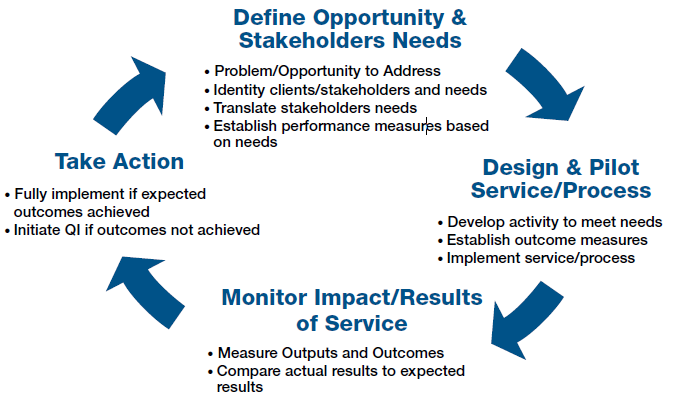
Quality Planning Cycle

Quality planning tools

ToolPurposeWhen to use
Force field analysisIdentify and distinguish between forces that support and hinder an issue or process factors affecting a process/productWhen wanting to reinforce positive factors and/or reduce negative factors
Affinity diagramGroup similar ideas together to make sense of a large or complex processAfter brainstorming; a useful "low tech" way of grouping customer needs
Interrelationship digraphIdentify cause and effect patterns, analyze customer needs, and determine key drivers of satisfactionWith an affinity diagram exercise
Failure mode effect analysisIdentify all possible errors and defects in a process/product/service end of design phase to determine back-up plans and controlsWhen designing or redesigning a process/product/service; use toward
Customer needs matrixUseful for grouping customer's needs by category, object, step, etc.Helps carry customer needs information through the process design

The Juran Trilogy

Quality Planning is often associated with the Quality Trilogy, also known as the Juran Trilogy, named after Joseph Juran. The Juran Trilogy consists of three primary managerial processes to manage quality within an organization – quality planning, quality control and quality improvement.

  • Quality Planning provides a system that is capable of meeting quality standards
  • Quality Control is used to determine when corrective action is required
  • Quality Improvement seeks better ways of doing things
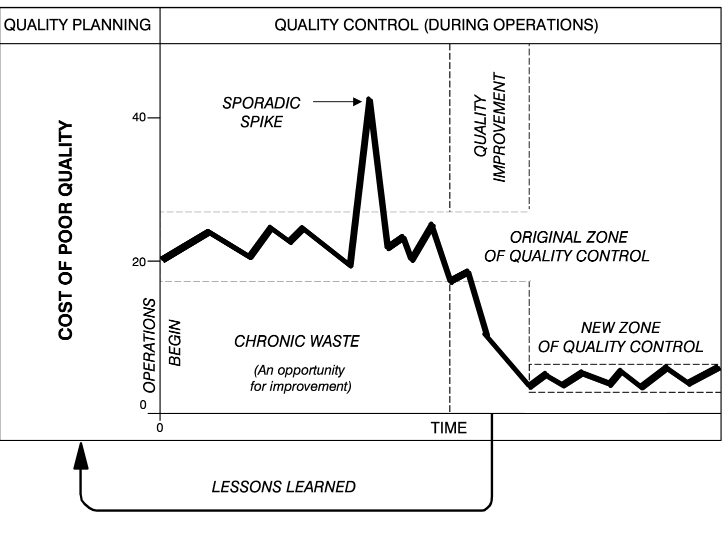
Quality Planning Diagram

More information

Improving the Quality of Planning Processes (PDF)
Marni Mason, Laurie Call, and Cindan Gizzi: MLC 2010 Open Forum

Sources

  1. Call L, Gizzi C, Mason M. (2011). Using Quality Planning in Public Health to Improve Results. National Network of Public Health Institutes: MLC Topical Brief.
  2. Juran J. (1986). The Quality Trilogy. Quality Progress.

Organizational QI plans

Are you looking for information on how to write a QI plan for your organization? Visit: Quality improvement plans.

Tags
  • public health practice
Last Updated: 12/31/2025
  • Facebook
  • X
  • Instagram
  • LinkedIn
  • Youtube

About MDH

  • About Us
  • Grants and Loans
  • Advisory Committees

Legal & Accessibility

  • Privacy Policy
  • Equal Opportunity
  • Feedback Form

Careers at MDH

This is an official website of the State of Minnesota. Visit Minnesota.gov for more information.